 +91 9390683154
 +1 (551) 222-0070



TL;DR — What You'll Learn
Explore essential cybersecurity best practices to protect your cross-platform applications from threats and vulnerabilities...
Introduction
Cross-platform applications have completely changed the digital landscape by enabling companies to connect with customers on a variety of platforms and devices. However, this convenience is accompanied by increased cybersecurity concerns, such as data breaches, illegal access, and API vulnerabilities. Maintaining app integrity and safeguarding user data require strong security measures.
Through the implementation of best practices like data encryption, secure API connectivity, robust authentication, and frequent security audits, developers can protect their apps from online attacks. In an increasingly interconnected world, a proactive approach to cybersecurity not only guarantees long-term success but also increases user trust.
Understanding the Security Risks in Cross-Platform Apps
Since cross-platform applications are made to run on many hardware, operating systems, and networks, hackers find them to be appealing targets. Among the most prevalent security threats are the following:
- Violations of Data: Access to private user data without authorization.
- Issues with the API: App features might be made vulnerable to hackers via weak API security.
- Antivirus software and reverse engineering: App code can be altered and decompiled by attackers to take advantage of security holes.
- Attacks by one person in the middle (MITM): Data interception may occur as a result of insecure network communication.
Good security measures must be incorporated into the app development process in order to mitigate these threats.
Best Practices for Securing Cross-Platform Apps
Although cross-platform programs provide smooth operation on a variety of devices, they also present particular security issues. Strong security measures must be put in place to safeguard user information and stop online attacks.
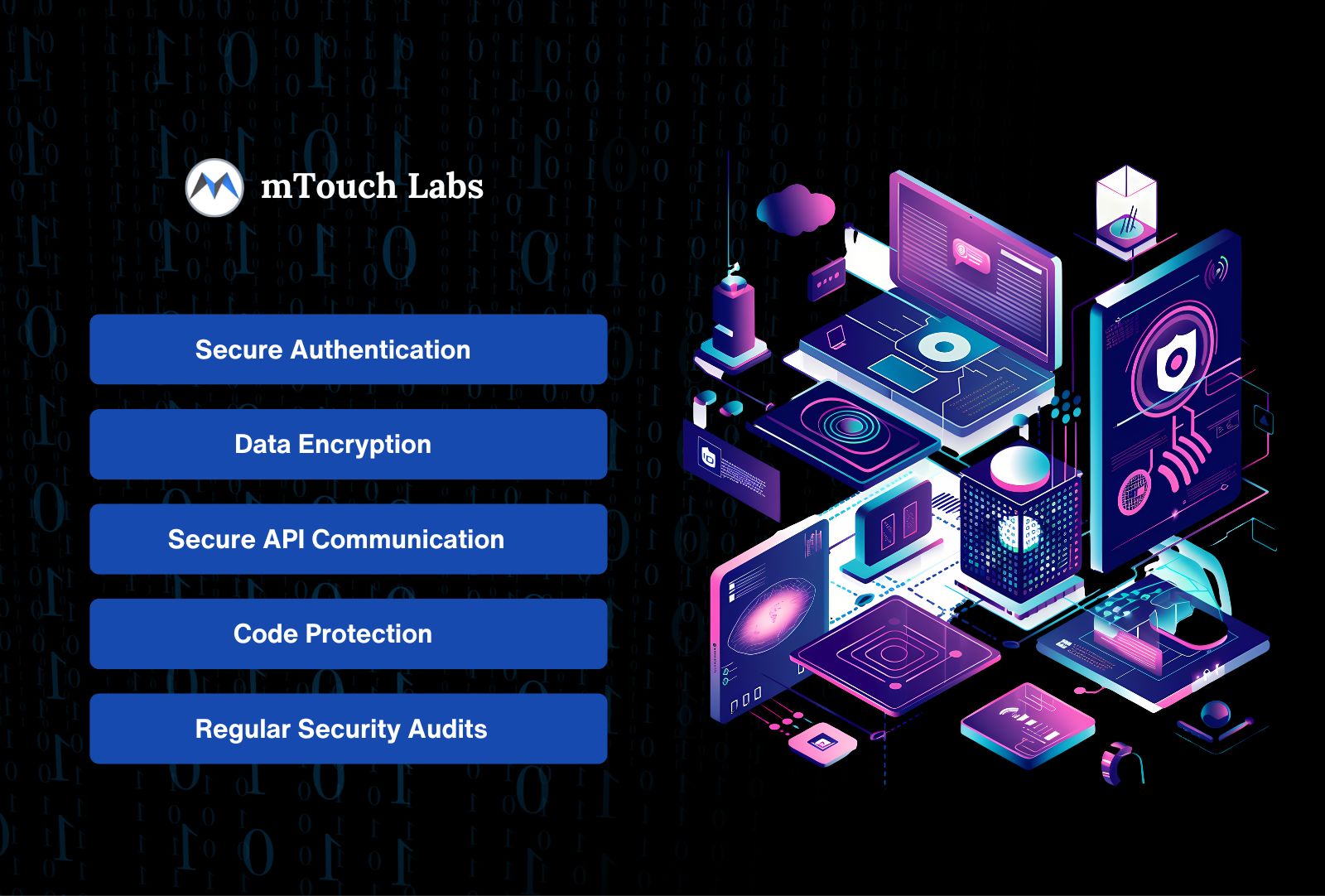
1. Put in place safe authentication procedures
The first line of protection in cybersecurity is user authentication. Only authorized users will be able to access the app thanks to the use of robust authentication measures.
- To increase security, use Multi-Factor Authentication (MFA).
- For safe user authentication, utilize OpenID Connect and OAuth 2.0.
- To stop brute-force attacks, enforce strong password restrictions.
2. Encrypt Data While It's in Transit and at Rest
Sensitive information is shielded from unwanted access by data encryption.
- AES-256 encryption should be used for data storage.
- For safe data transfer, use SSL/TLS encryption.
- Sensitive information should not be locally stored unless it is absolutely required.
3. Communication via Secure API
In cross-platform applications, APIs are essential because they allow the app and its backend to communicate with one another. Attackers may be able to access vital features through insecure APIs.
- For safe access, use token-based authentication (JWT or OAuth).
- Use rate limitation to stop DDoS assaults and API misuse.
- Use IP whitelisting and CORS restrictions to limit API access.
4. Guard Against Code Tampering and Reverse Engineering
Decompiling your software allows attackers to examine its functionality and take advantage of any weaknesses.
- To make the source code for your app hard to read, use code obfuscation.
- Put in place tamper detection systems that notify you in the event that changes are found.
- Check the codebase of your application frequently for malicious injections.
5. Perform Frequent Security Testing and Audits
Regular evaluations are required because security threats are always changing.
- To identify weaknesses and replicate cyberattacks, conduct penetration testing.
- To find security flaws, analyze both static and dynamic code.
- Put bug reward schemes into place to let ethical hackers identify vulnerabilities.
Conclusion
Cybersecurity is a continual process that calls for constant testing, observation, and adjustment to emerging threats. Developers can create dependable, safe, and globally compliant cross-platform applications by incorporating these best practices.
Giving security first priority when developing apps is not an option at a time when cyber threats are ever more complex; it is a need. Whether you're creating a banking app, social networking app, or eCommerce platform, putting strong cybersecurity safeguards in place can guarantee long-term profitability and consumer trust.
By proactively addressing cybersecurity, you can stop data breaches, protect private data, and provide your users with a safe online experience.
Frequently Asked Questions
What are the most common security threats in cross-platform apps?
How can I protect my app from reverse engineering?
What encryption methods should I use for cross-platform apps?
🎯 Key Takeaways
Explore essential cybersecurity best practices to protect your cross-platform applications from threats and vulnerabilities...
